
Six Ways to Practice Vocabulary That Aren't Flashcards
Flashcards train one skill out of six. Here are the six vocabulary practice methods every learner needs, what each exercise looks like, and how to choose the right one.
Six Ways to Practice Vocabulary That Aren't Flashcards
Flashcards get the most attention in language learning, and there is a reason for that. Spaced repetition works, and the apps that have built whole businesses on it (Anki, Quizlet, the SRS-shaped parts of Duolingo) are not selling a fake promise.
The trouble is that flashcards train one specific skill: pulling a word from memory when prompted by its translation or definition. Vocabulary needs six.
If your only practice format is flashcards, the other five skills are quietly atrophying while you accumulate "known word" counts. This post walks through all six jobs, what each one looks like as an exercise, and how to tell which one you should be doing right now.
You can do all six with paper and a notebook. You can do all six in a structured app. The format matters less than the diagnosis.
1. Recall — pulling the word out
The skill: Given a meaning, produce the word.
This is what a flashcard with the translation on the front and the target word on the back trains. You see "to forget" and you need to come up with olvidar, or vergessen, or whatever the equivalent is in your target language. The word is in there somewhere. The exercise is the retrieval.
Recall is the foundation skill. Without it, none of the others work, because you cannot use a word you cannot find. It is also the skill flashcards are best at training, which is one reason flashcard-only routines feel productive for so long. You are visibly improving on the one thing being measured.
The risk is over-investing in it. After a certain point, additional recall practice on a word you have already retrieved correctly twenty times stops paying back. The word is recall-ready. It needs different work to become use-ready.
Do this when: A word is new, or you have noticed it slipping out of memory between sessions.
Format that targets it: Flashcards with translation on the front. Fill-in-the-blank where the blank is the only clue.
2. Recognition — knowing it when you see it
The skill: Given the word, recognise its meaning.
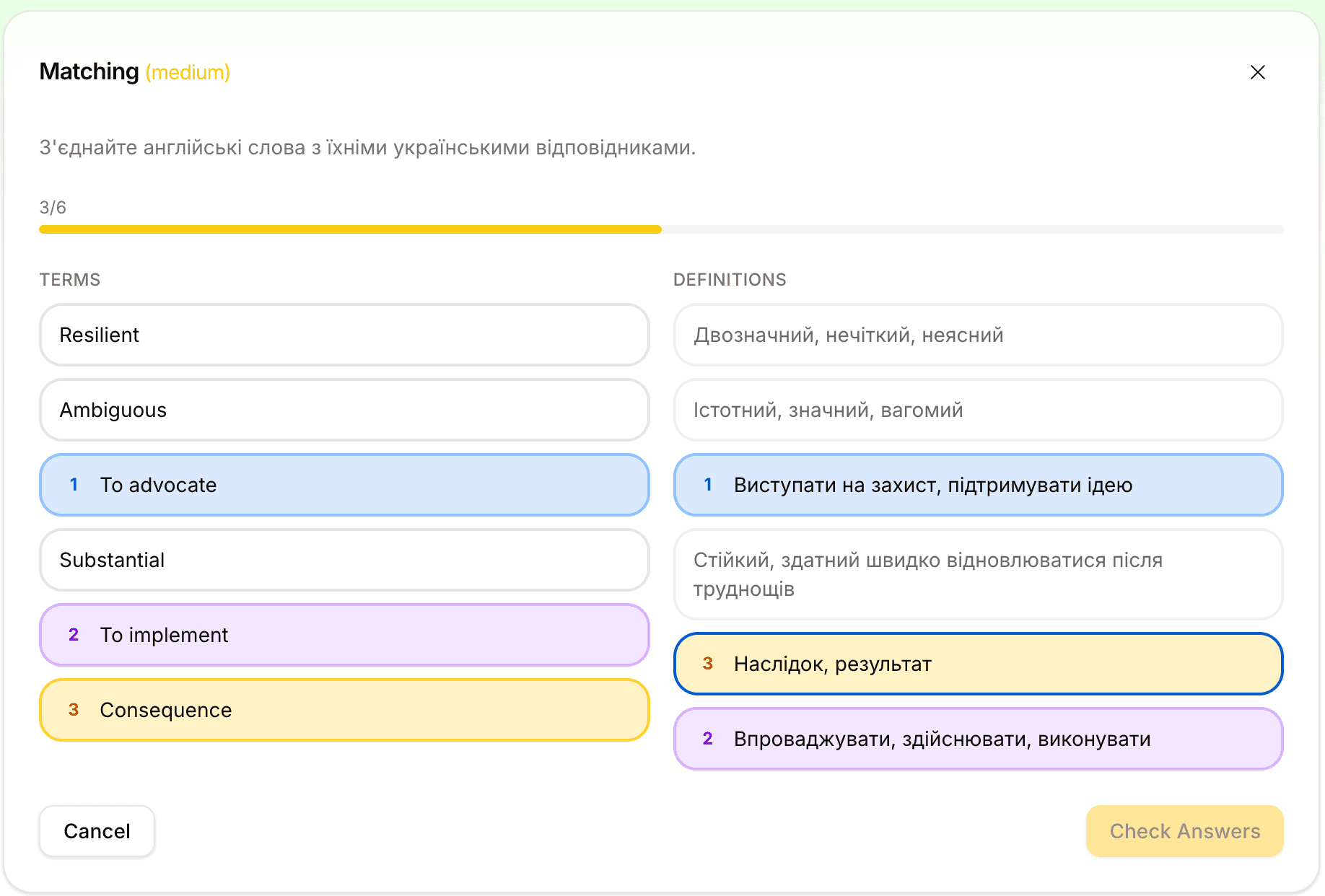
The reverse direction. You see olvidar in a sentence and know it means "to forget" without consciously translating. This is the skill that does the heavy lifting when you read or listen to your target language at speed.
Most learners have more recognition than they realise. You can recognise thousands of words in a foreign language long before you can produce them. That gap is normal, and it works in your favour: receptive vocabulary is what makes reading and listening possible, and reading and listening are where you pick up the most new words.
The mistake is treating recognition and recall as the same skill. They are trained by different exercises, and many learners spend hours on recall drills wondering why their reading speed has not budged.
Do this when: You can produce a batch of words in isolation but stumble when reading them in context. Also useful as a quick warm-up at the start of a session, because recognition takes little effort and gets the right vocabulary loaded into working memory.
Format that targets it: Matching. Multiple-choice where the prompt is the target word and the options are meanings.
3. Production — using it in a sentence
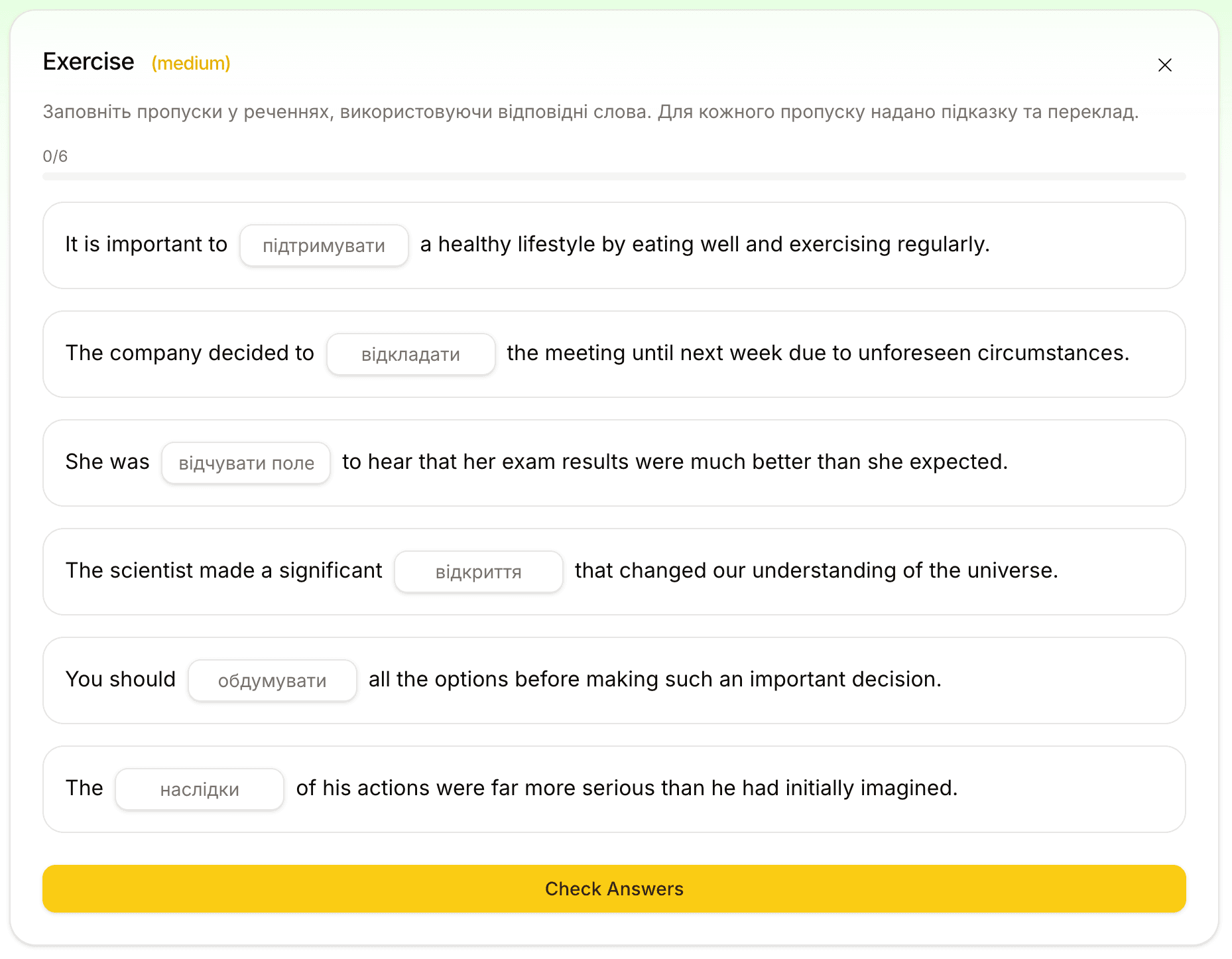
The skill: Place a known word into a sentence frame where it fits grammatically and semantically.
This is the step that exposes whether you actually own a word or whether you are just renting it.
You can know that conscientious means "careful and thorough." You can produce it from a flashcard. You can recognise it in a text. Production starts when you try to finish "she is a conscientious _" with a noun that fits, or to use the word in a sentence about a colleague that does not sound like a translation exercise.
Production reveals collocation gaps (which adjectives pair with this noun?), register problems (this word is too formal for the context I just used it in), and grammatical missteps (this verb takes a different preposition than its English equivalent).
It is the most cognitively expensive of the six skills and the one that flashcards almost completely ignore. It also pays off most when you actually speak or write.
Do this when: You are preparing to write or speak. Or when you have noticed that a word you "know" never makes it out of your head and into your output.
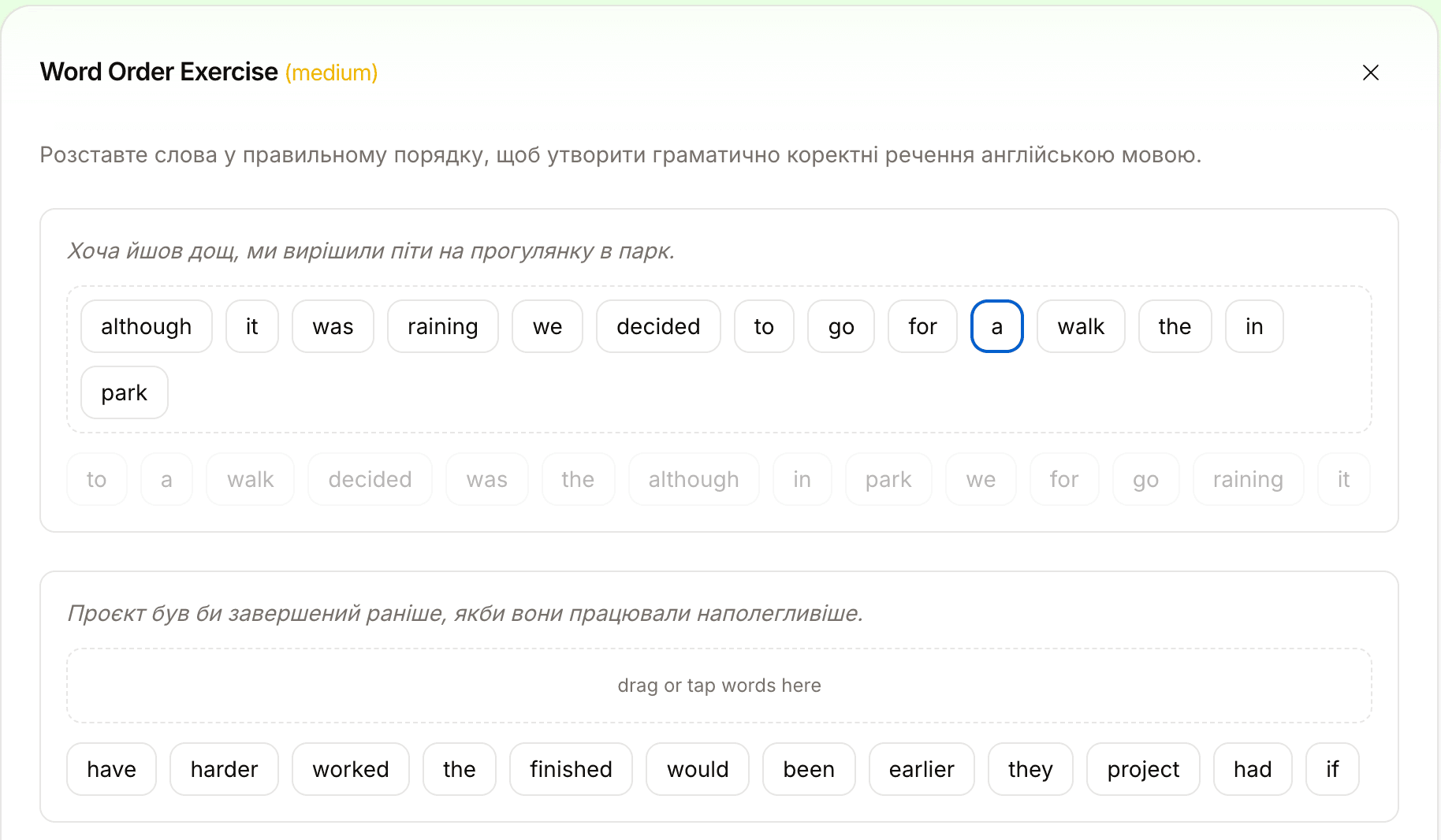
Format that targets it: Fill-in-the-blank without translation hints. Sentence-construction tasks. Word-order exercises where you arrange a scrambled sentence, which train the syntactic intuition that production depends on.
4. Comprehension — meeting the word in context
The skill: Encounter a word inside connected prose and understand both the word and what it is doing in the passage.
This is the skill the previous three feed into. Recall, recognition, and production all happen one word at a time. Comprehension is what happens when 200 words arrive at once and you have to navigate them.
A learner with 2,000 well-comprehended words can read further than a learner with 4,000 flashcard-known words, because the second learner is still doing translation in their head for every fourth word and running out of working memory by the second paragraph.
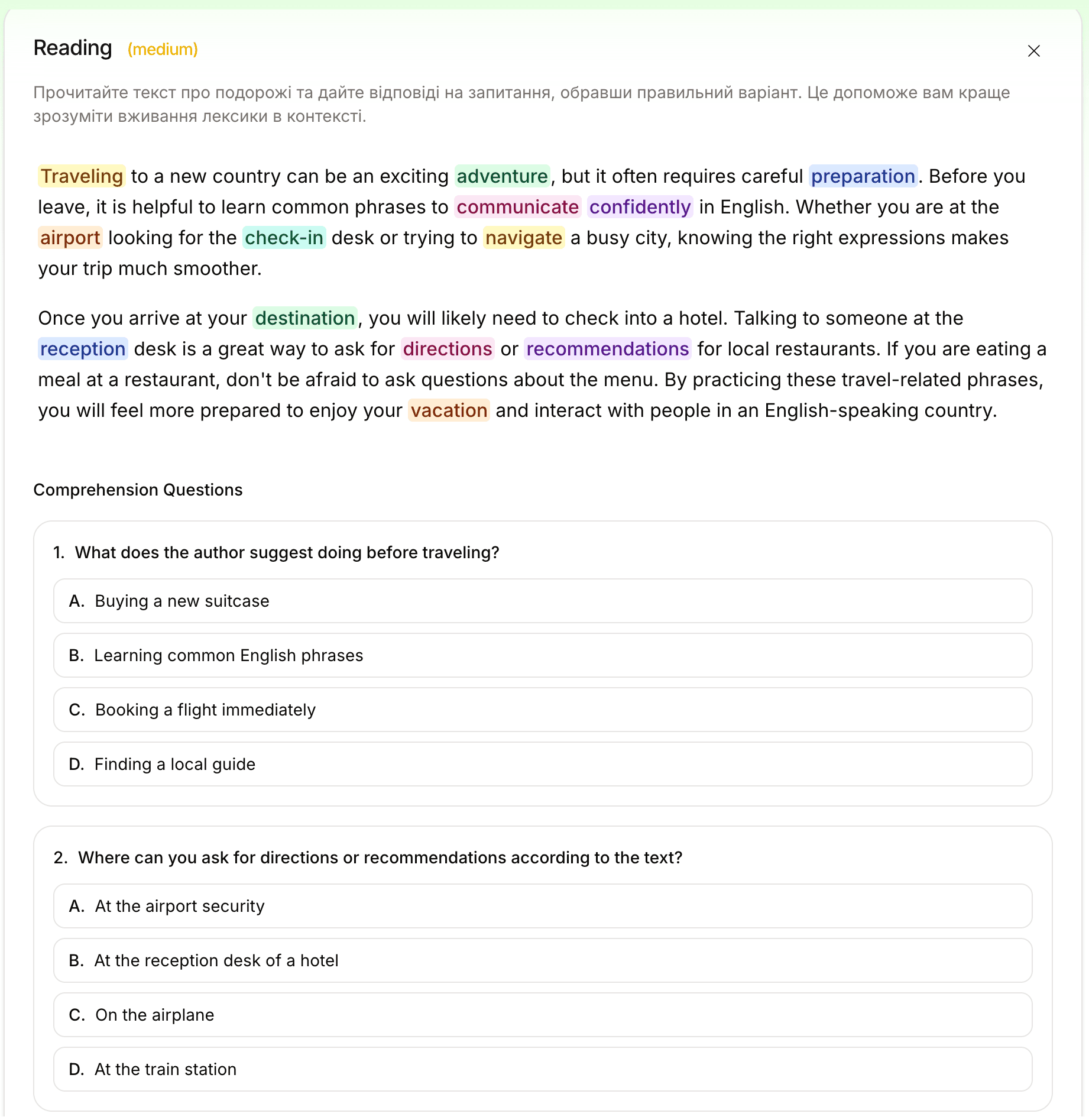
The exercise format here is reading. Multiple-choice on a single sentence is a recognition test with extra steps. Real reading practice means a passage of meaningful length (150 words is roughly the minimum that exercises navigation across multiple ideas), followed by questions that require you to have understood the passage as a whole, not just to have decoded each word in isolation.
The useful trick is to read passages built from vocabulary you are actively studying, rather than generic graded readers. That way every paragraph does two jobs: it trains reading speed and consolidates the specific words you have been working on.
Do this when: A batch of words has been on your active list for a week or two and you want to know which ones have stuck. Also when you need to bridge from flashcard-style study to real reading.
Format that targets it: A passage of 150–250 words built around your current vocabulary, followed by 3 to 5 comprehension questions in the target language.
5. Grammar pattern — choosing the right form
The skill: When a word can take multiple forms or two similar words compete for the same slot, pick the correct one.
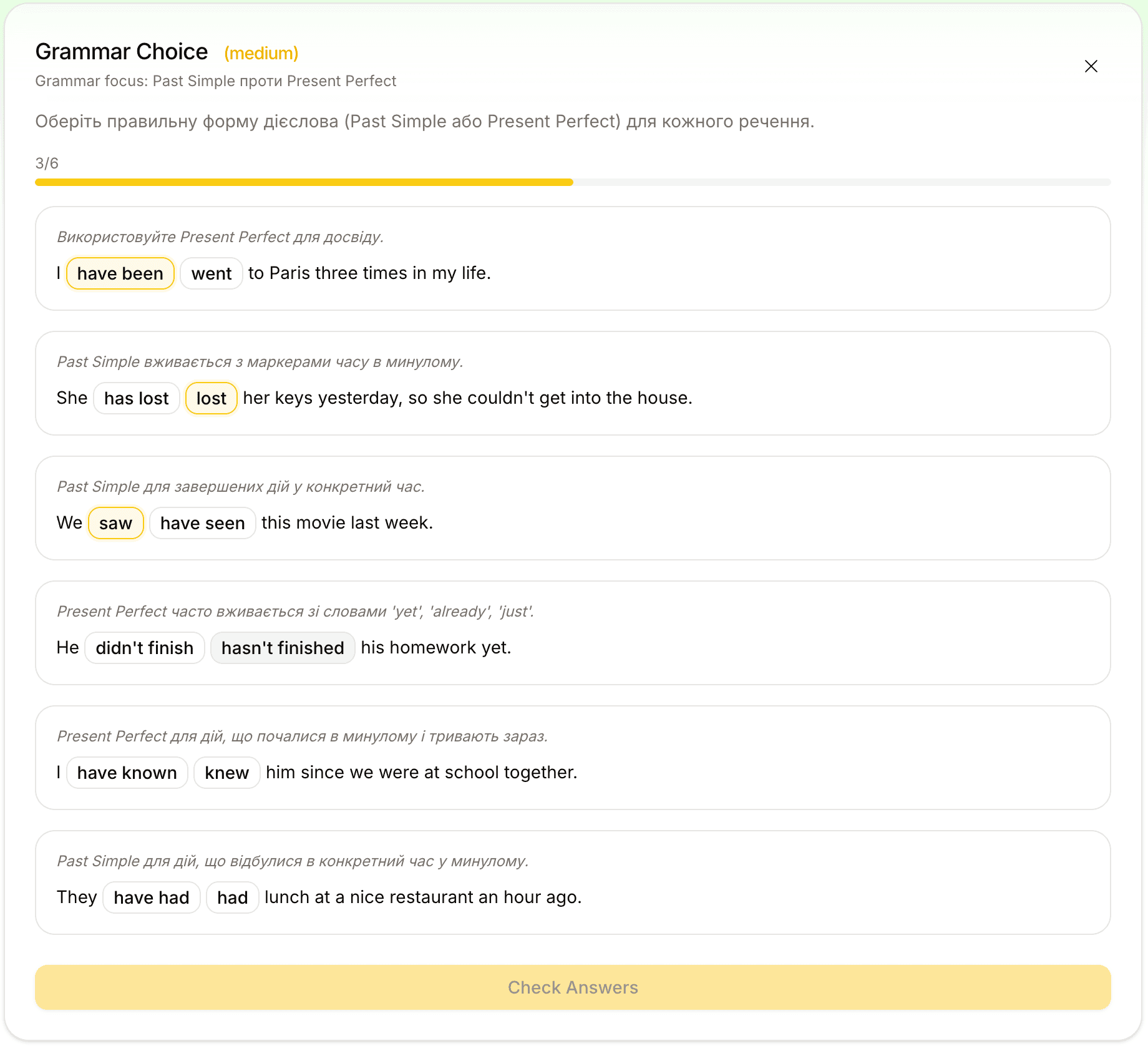
This is the skill that lives between vocabulary and grammar. You know the words. The question is which one belongs in this sentence.
Spanish learners know it as ser versus estar, por versus para. English learners know it as past simple versus present perfect, make versus do, the dozen prepositions that English insists on using as if they were random. French learners know it as gender agreement, German learners as gender and noun cases. Every language has pairs or small sets like these, where vocabulary knowledge alone does not tell you which one is right in context.
A flashcard cannot train this. It asks what a word means. This skill asks which form fits a given sentence frame, and why.
The exercise format is constrained choice: a sentence with a blank, two plausible options, and feedback on why the right answer is right. Without that explanation step, you are just guessing repeatedly and hoping pattern recognition kicks in. With the explanation, you are building an actual rule.
Do this when: A specific grammar contrast keeps showing up in your mistakes. You can usually name it. "I never know whether to use por or para" is a useful self-diagnosis.
Format that targets it: Two-option multiple choice on a single sentence, with an explanation revealed after each answer.
6. Error spotting — reading critically
The skill: Scan a sentence written in your target language, identify what is wrong, and name the fix.
This is the rarest of the six in study routines, and one of the most useful for anyone preparing to write or be edited.
Production asks you to build a sentence from scratch. Error spotting asks you to look at someone else's sentence (or, more usefully, at a sentence that approximates a mistake you would make) and step back into the editor's role.
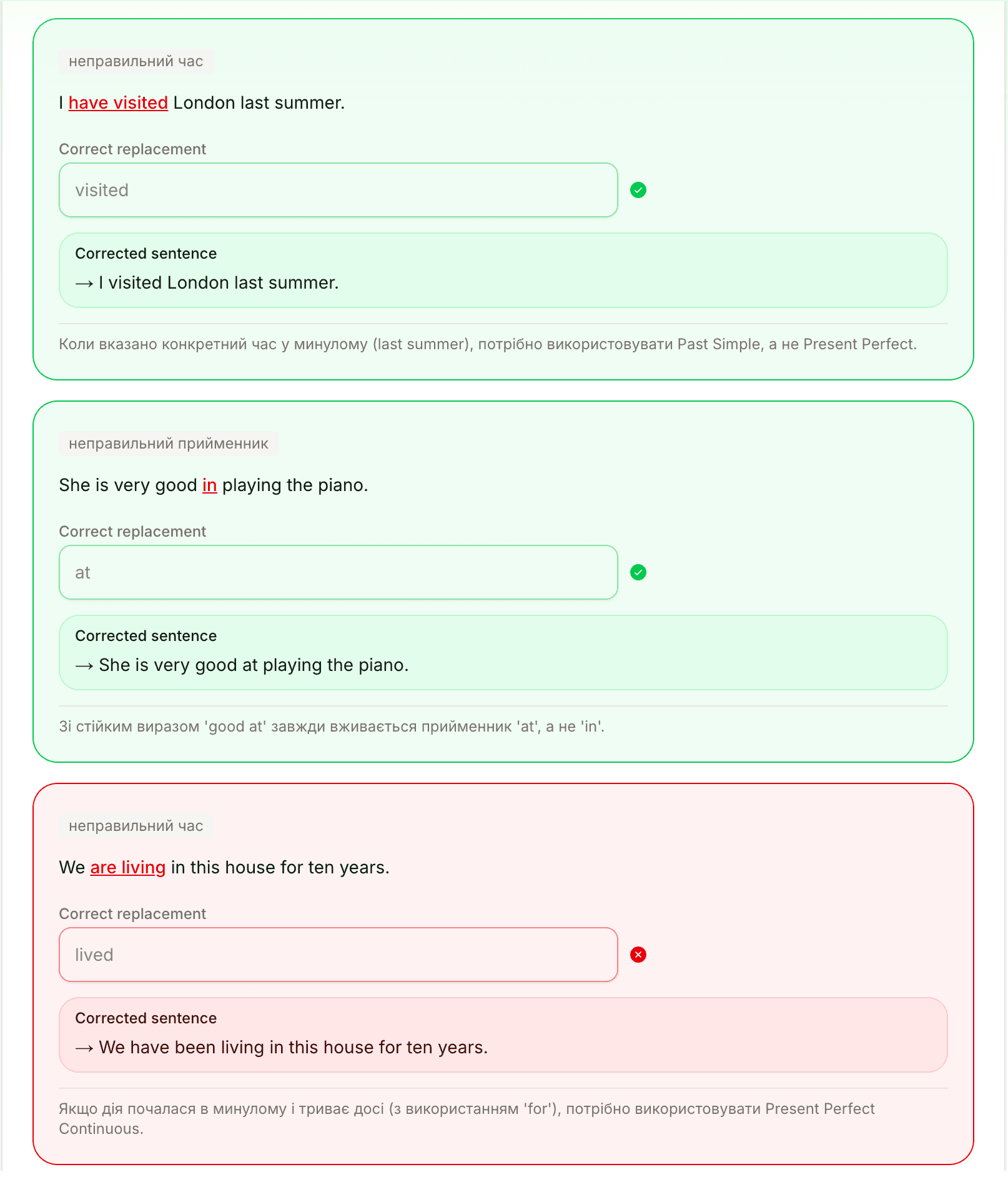
Writing in a foreign language without an editing pass is how learners ossify their own errors. Every time you write a sentence with a wrong preposition and nobody flags it, your brain gets one more rep that "this is how the sentence goes." Error-spotting exercises are practice runs at the editing pass that your own writing needs.
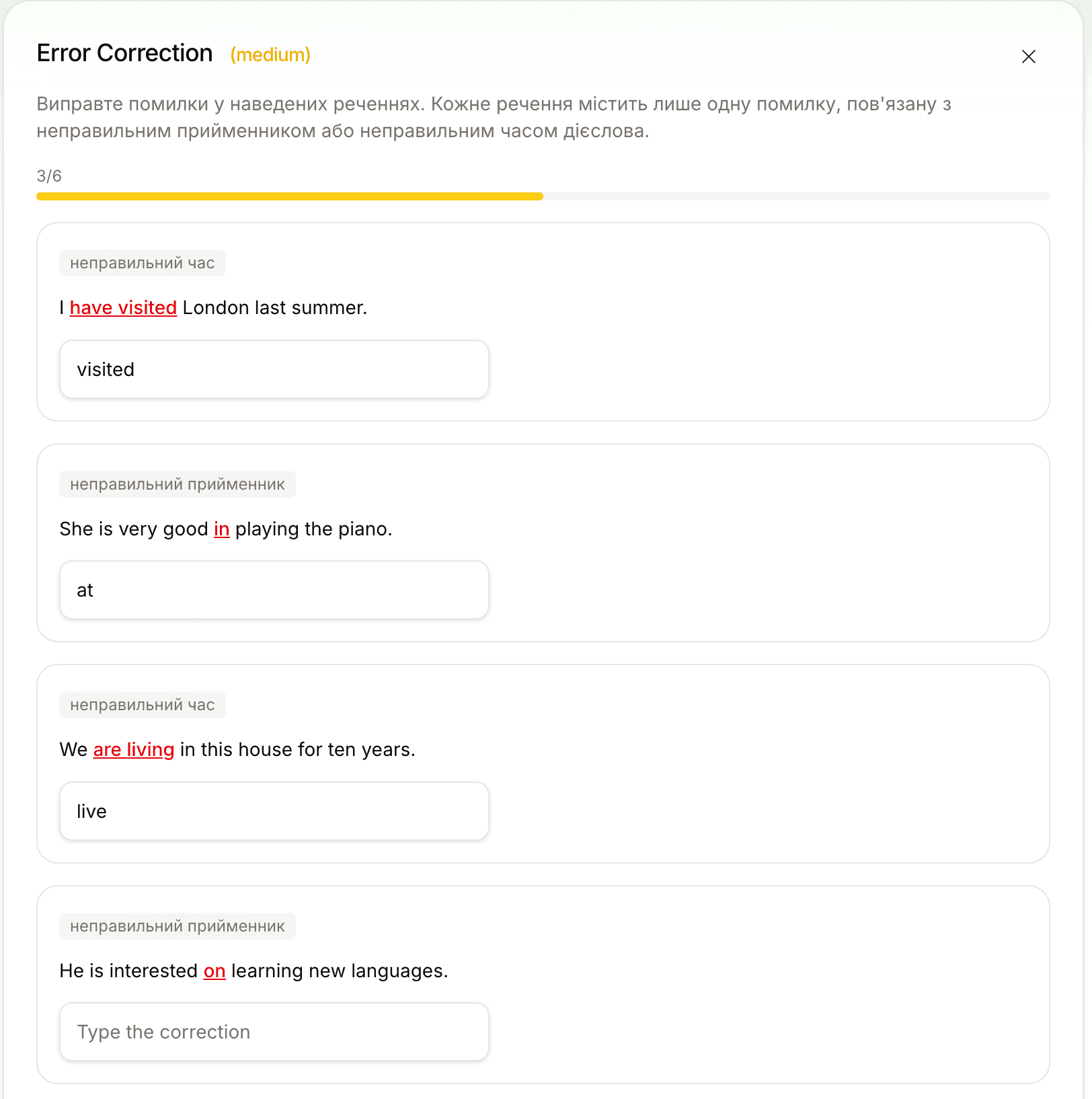
The format works only if the errors are realistic. A sentence with an obviously wrong word does not train anything: you spot it instantly and learn nothing. The errors that train are the ones you would have written yourself, such as a verb in the wrong tense, an agreement you forgot to make, or a preposition borrowed from your native language.
Do this when: You write in your target language and want to build the self-editing habit, which improves your writing faster than writing without feedback. Especially valuable before any writing exam.
Format that targets it: A sentence with exactly one error for you to find and correct, followed by an explanation of what the error was and why your correction is right.
How to use the six together
Doing all six every day is overkill, and the returns drop off fast.
A more useful approach is to diagnose, then choose:
- A word is new → recall (flashcard, fill-in-the-blank)
- You can produce a batch but stumble in reading → recognition (matching)
- You can recognise but rarely produce → production (sentence construction, word order)
- A batch of words has been on your list for two weeks → comprehension (read a passage that uses them)
- A specific grammar contrast keeps tripping you up → grammar pattern (two-option choice with explanations)
- You are about to write something important → error spotting (find-the-mistake)
Flashcards appear in one of these six bullets. The other five cover reading, writing and correcting, which flashcards never touch.
The case for doing all six in one place
You can build a six-exercise routine across multiple apps and a notebook. Plenty of learners do. Anki for flashcards, a graded reader for comprehension, a textbook for grammar drills, a writing tutor for error correction. It works if you have the discipline.
The hidden tax is that none of those tools know about each other. The vocabulary you are reviewing in Anki is not the vocabulary in your graded reader. The grammar your textbook is drilling is not the grammar your writing tutor is flagging. Every tool runs on its own vocabulary set, and you do the coordination work.
A single workspace lets the same set of saved words feed all six exercise jobs. The matching exercise warms up the words. The fill-in-the-blank tests production. The reading passage embeds them in prose. The grammar choice tests the grammar those words trigger. The error correction trains the editing pass on sentences those words appear in.
That is the case for Lingoverse, if you want one. We built it because we wanted exactly this: save the word once, practice it six different ways, never lose track of what is supposed to be sticking and what is not.
Next time you sit down to practice vocabulary, do not default to the format you always use. Ask which of the six jobs your vocabulary needs right now, then pick the format that does that job.