
Reading Comprehension Is the Exercise Vocabulary Apps Usually Skip
Flashcards build a vocabulary base, but reading is what makes it usable. Here is why reading comprehension matters more than its share of the exercise lineup suggests - and what changes when the passage is built from your own saved words.
Reading Comprehension Is the Exercise Vocabulary Apps Usually Skip
Open any vocabulary app and count the exercise types. You will get some combination of flashcards, matching, multiple choice, maybe a sentence with a blank. All of them work on the same scale: one word at a time, in isolation.
You do not meet words one at a time when you read a book, scan a news article, or follow a conversation. You meet them embedded in text, surrounded by other words, carrying part of a sentence, doing a job. The gap between "I know this word on a flashcard" and "I noticed this word in a paragraph and understood what it was doing there" is wider than most apps admit.
We recently shipped six exercise types in Lingoverse. Five of them work at the word or sentence level. The sixth, reading comprehension, works on a whole passage, and it trains things the other five cannot.
The problem with words in isolation
Flashcards work. We are not here to argue otherwise. Spaced repetition on isolated words is one of the most studied techniques in language learning, and it does what it claims to do: it moves vocabulary from short-term to long-term memory, reliably and with measurable retention curves.
The trouble is what flashcards do not train.
They do not train reading at speed. They do not train disambiguating a word from its neighbours ("bank" the riverbank or "bank" the institution). They do not train the moment where you encounter a word you half-remember, fail to consciously translate it, and still get the gist of the sentence from context. That last skill, passive comprehension under time pressure, separates a learner who knows 3,000 words on flashcards from a learner who can read a newspaper.
Paul Nation's work on vocabulary acquisition makes a similar case: deliberate word study should be balanced with plenty of meaning-focused reading, because recognising a word on a card and understanding it in running text are different skills. For an app, that means flashcards build a base and reading makes the base usable.
Most vocabulary apps stop before the reading step. Some treat a multiple-choice question inside one sentence as if it covered reading. A single sentence has no build-up of meaning across paragraphs and no moment where one word reframes the one you read two lines ago.
What changes when the reading is generated from your own words
When you read a generic graded reader, the vocabulary in the text is whatever the publisher selected based on a CEFR level. It is calibrated for an average learner at your level, not for you. The words you have spent the past two weeks trying to remember may or may not appear. The words you have already mastered are scattered through the text alongside them, taking up reading bandwidth without doing learning work.
Generated reading practice flips that ratio.
When the passage is built from words you saved this week, every paragraph is doing two jobs at once. The first job is the normal one: training reading speed, context inference, the rhythm of how clauses connect. The second job is vocabulary. The passage centres on the words you most need to consolidate, repeats them, and makes you work out their meaning from context if you have not fully internalised them yet.
What we built, concretely
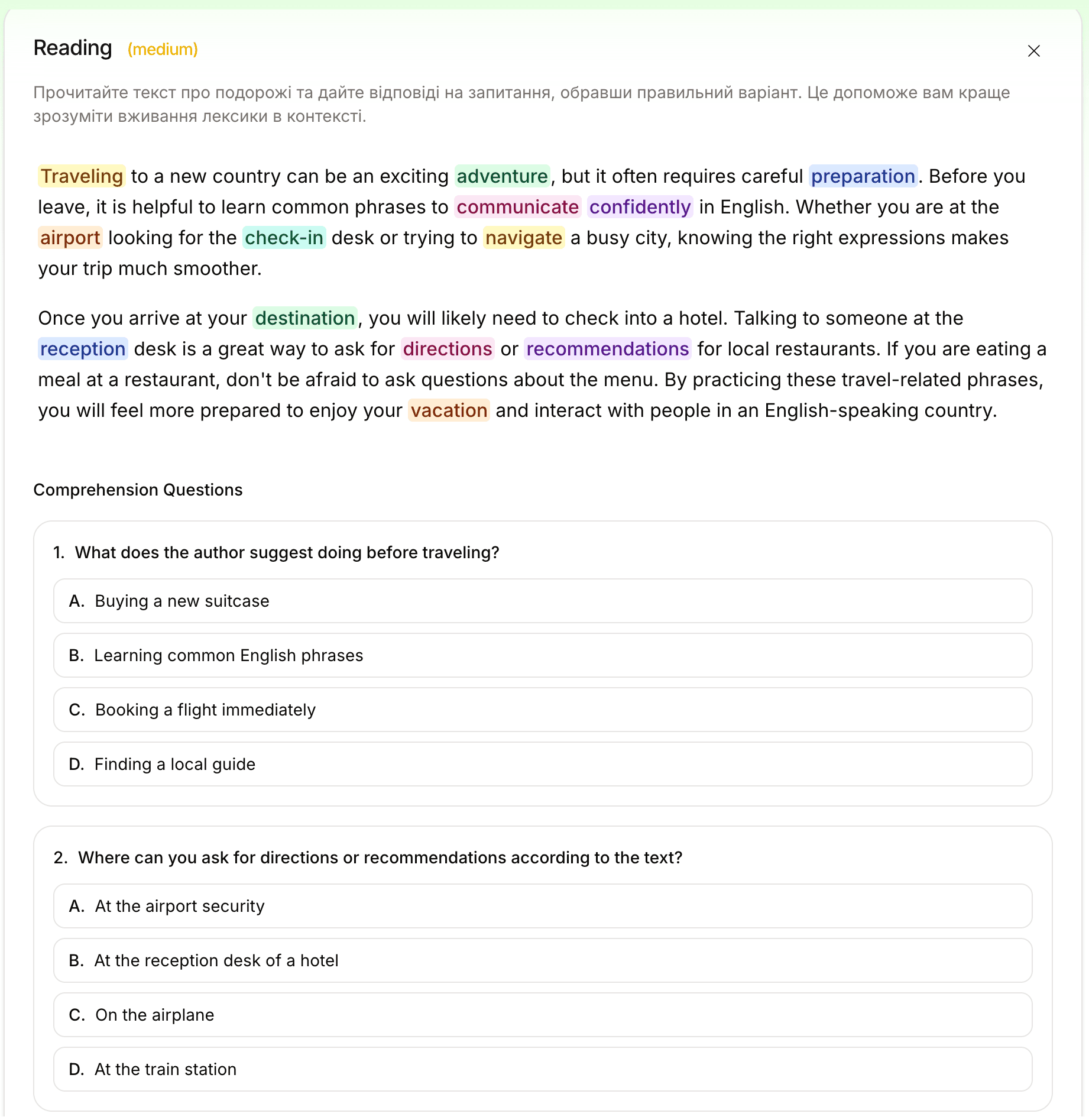
In Lingoverse, a reading exercise starts from a single Space of your saved vocabulary. You ask for one in chat ("give me a reading exercise on my food words" works, "reading practice" works if the context is obvious), and the tutor generates a 150 to 250 word passage in your target language. It then asks 3 to 5 multiple-choice comprehension questions in the same language.
Four details that took us a while to get right:
The highlights are stable. Each vocabulary word gets the same soft pastel colour every time it appears in the passage. You read past the same yellow-highlighted word in paragraph one and paragraph three, and your eye recognises it as the same anchor. The colour is a memory cue, so assigning it at random would defeat the point.
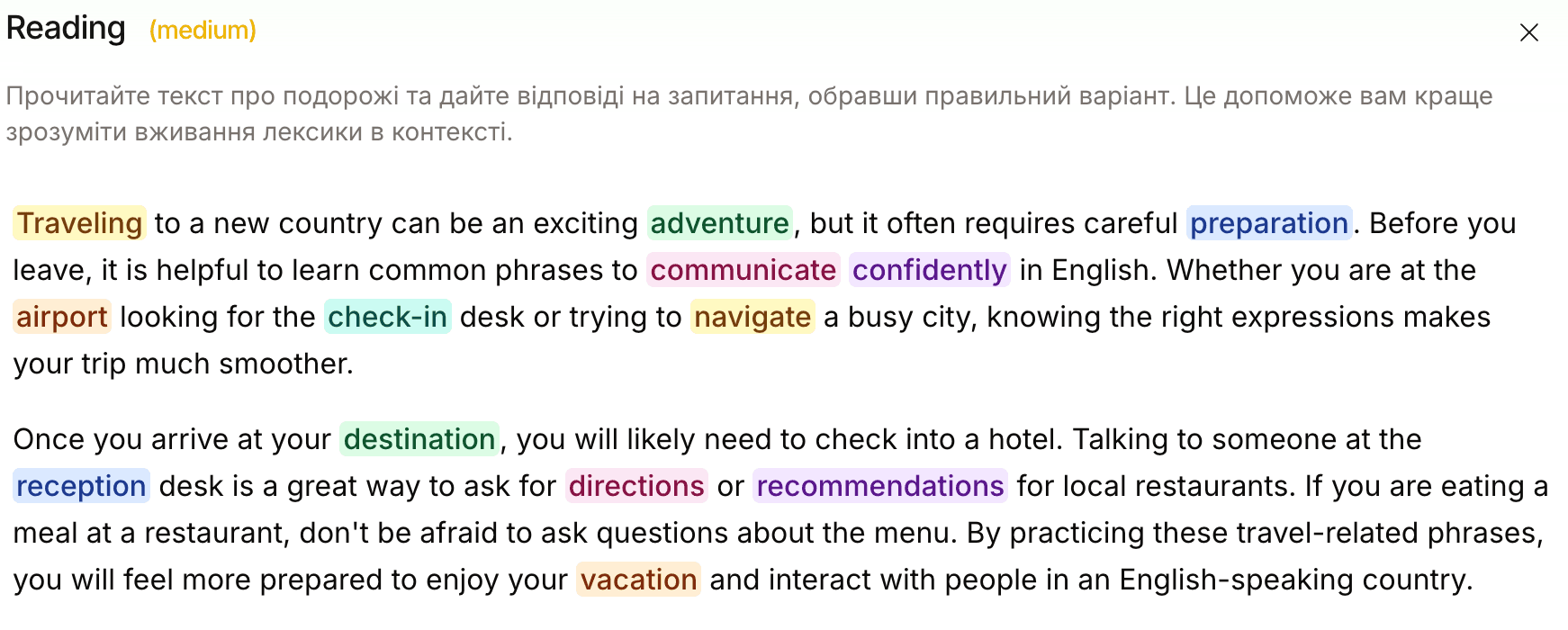
The passage uses a weighted subset of your words. A 200-word passage cannot use 30 vocabulary items naturally - it would read like a word list dressed up as prose. The generator picks the 8 to 15 highest-priority words from your Space (recently added, recently struggled with, or context-relevant to the requested topic) and builds the passage around those. The rest of your vocabulary remains available as connective tissue, but does not have to appear.
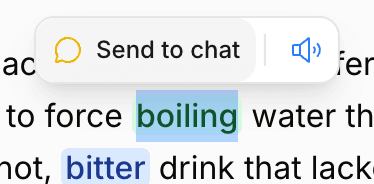
A passage can feed your next vocabulary list. Highlighted words, and any other word in the passage, can be sent to chat in one click. From there you can ask what it means, save it to your vocabulary, and turn it into the next exercise. Reading becomes a full loop: practice known words, discover new ones, then keep training them.
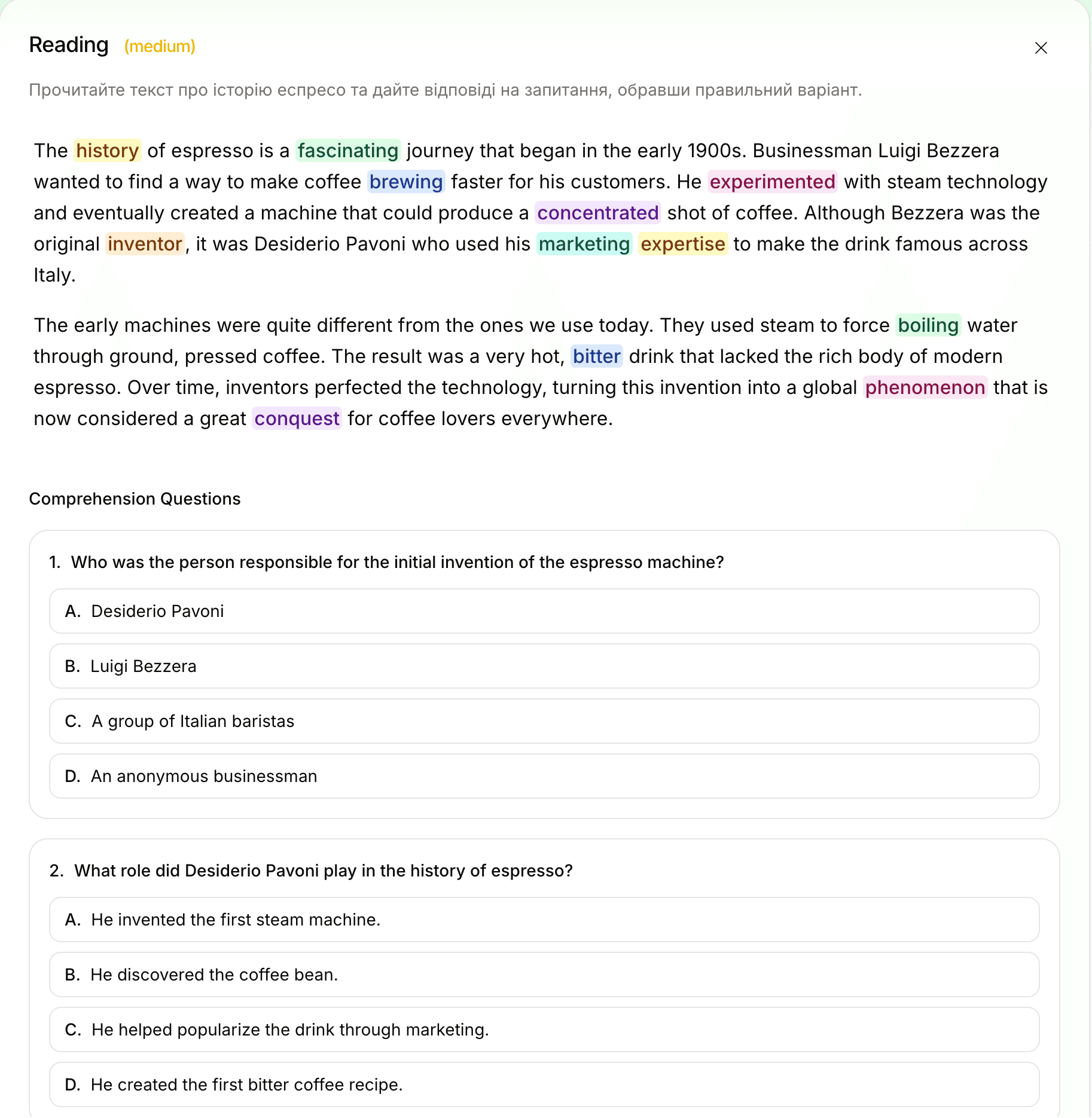
Real-world context is optional and useful. When a topic benefits from outside context, the reading generator can pull a few real-world facts before writing: actual statistics about octopus intelligence, actual dates from the history of espresso, an actual place name from the region you wanted to read about. The passage stops feeling like an AI hallucination of the topic and starts feeling like something written by someone who looked it up.
When to reach for it
Reading comprehension is not the right exercise for everything. If a word is brand new and you have not even confirmed its meaning yet, matching is faster. If you can recognise the word but cannot produce it, fill-in-the-blank is more targeted. If a grammar form is the issue, grammar choice is the tool.
Reading comprehension earns its place at a specific moment: when you have a batch of words that have been in your Space for a week or two, you can recognise them in isolation, and you want to know whether they are doing real work. The honest test of vocabulary is whether you can read a paragraph that uses the word and understand the paragraph, which is harder than defining it.
If the answer is yes, the word has graduated. If the answer is no, you have found the words that have not stuck, even though they passed every flashcard review.
The shape of a real reading habit
Reading also deserves a higher place in a vocabulary routine because it grows naturally into a habit.
A daily flashcard session has a hard ceiling. You can do 50 cards or 100 cards or (if you are a particular kind of person) 300 cards, but past a certain point you are training your tolerance for tedium more than your language. Reading does not have the same ceiling. A learner who reads one article a day in their target language for a year ends up somewhere that no amount of flashcard volume can take them, because reading trains the parts of comprehension that isolated drill cannot reach.
In-app reading exercises are a bridge to that habit. We generate reading practice from your own vocabulary for the stretch where you have 200 saved words in a Space and feel ready to read something real, but every "real" text you try is still 30% above your level.
A generated passage at your exact vocabulary frontier, built from the words you already know plus the ones you are working on, is the rung between flashcards and the article you want to read. The other five exercise types get new words to the point where you recognise them, and reading checks whether they hold up in a paragraph.